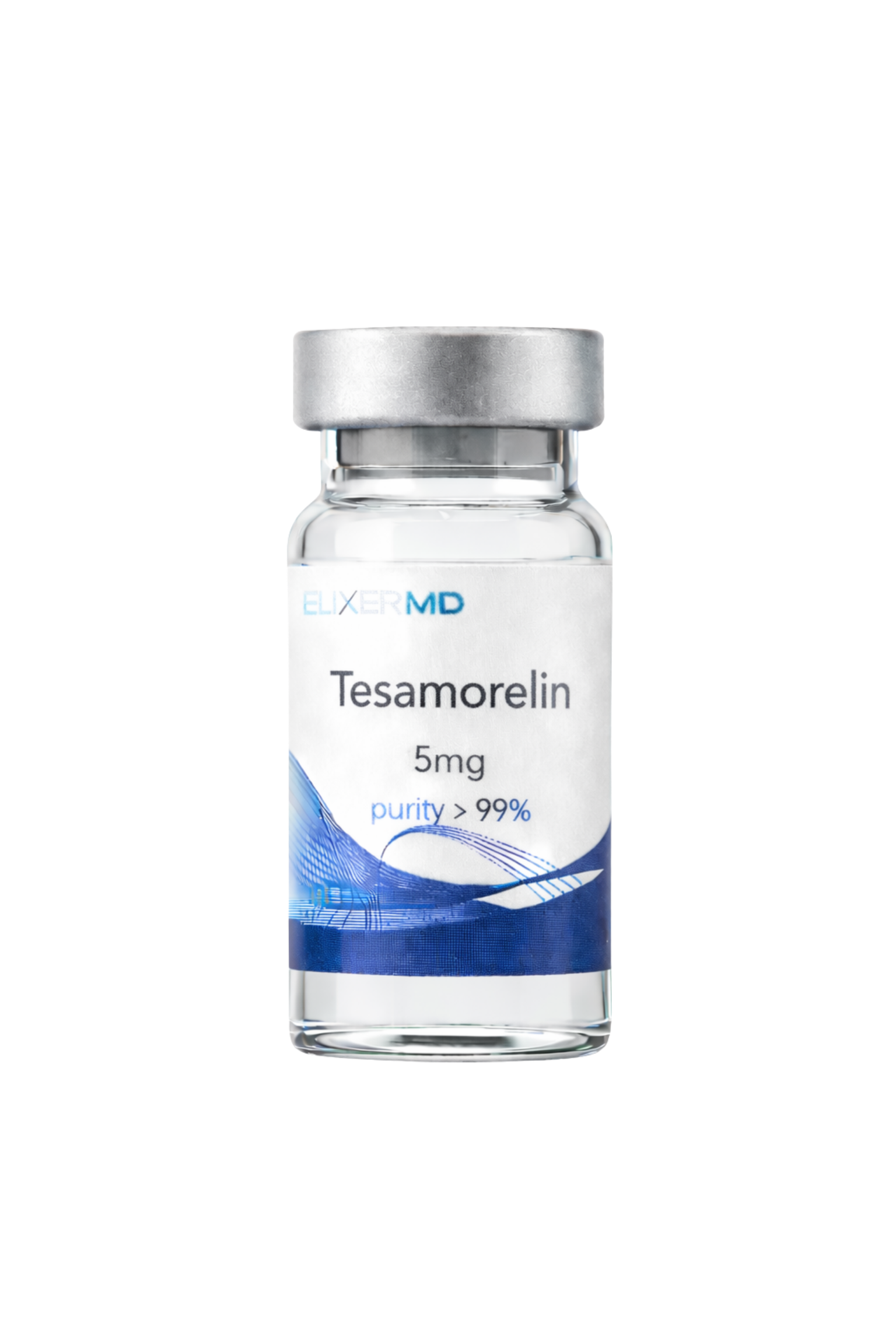
Tesamorelin (5mg) Research Peptide
$65.00
Tesamorelin is a synthetic analog of growth hormone–releasing hormone (GHRH) designed for stability and prolonged receptor activity. It is primarily used in research investigating metabolic regulation, lipolysis, and endocrine signaling. Tesamorelin provides a model for studying GHRH receptor agonism and its effects on growth hormone secretion pathways in controlled laboratory environments.
In stock
Additional info
Introduction
Tesamorelin is a synthetic peptide analog of human growth hormone–releasing hormone (GHRH), consisting of 44 amino acids with a modification that enhances resistance to enzymatic degradation. By stimulating the GHRH receptor in the anterior pituitary, Tesamorelin promotes the endogenous release of growth hormone in in-vitro and preclinical research models. Researchers utilize Tesamorelin to explore mechanisms underlying metabolism, lipolysis, and energy regulation, particularly in studies involving adipose tissue and insulin sensitivity.
Stability and Bioavailability
The peptide’s substitution of a trans-3-hexenoic acid group at the N-terminus provides Tesamorelin with improved proteolytic stability and extended half-life compared to native GHRH. This modification allows for sustained biological activity in vitro, enabling detailed analysis of receptor binding, signal transduction, and growth hormone pulsatility. Its molecular integrity and reproducibility make Tesamorelin ideal for experiments requiring prolonged incubation or repeated peptide exposure in cultured pituitary or hepatocyte cell lines.
Research Applications
Growth Hormone Regulation and Pituitary Function
Tesamorelin binds selectively to the GHRH receptor, leading to cyclic AMP–mediated activation and growth hormone secretion in controlled studies. It serves as a reference compound in examining pituitary regulation and receptor desensitization mechanisms.
Lipid Metabolism and Adipose Tissue Research
Due to its role in stimulating growth hormone and insulin-like growth factor-1 (IGF-1) production, Tesamorelin is employed in studies assessing lipid metabolism, hepatic triglyceride turnover, and adipocyte activity. Research frequently explores its effects on visceral adiposity in metabolic and obesity-related pathways.
Endocrine and Cellular Metabolism
Laboratory models investigating glucose utilization and mitochondrial energy function often incorporate Tesamorelin to evaluate how growth hormone influences metabolic enzymes and mitochondrial biogenesis. It also aids in exploring the link between hormonal signaling and oxidative metabolism.
Summary
Tesamorelin is a potent and stable analog of growth hormone–releasing hormone that provides a reliable tool for metabolic and endocrine research. Its enhanced receptor activity and resistance to degradation allow scientists to examine growth hormone pathways and energy balance mechanisms with greater precision and reproducibility.
References
-
Falutz J et al., Metabolic effects of a growth hormone-releasing factor in patients with HIV, The New England Journal of Medicine (2007). PubMed
-
Stanley TL et al., Effect of tesamorelin on visceral fat and liver fat in HIV-infected patients with abdominal fat accumulation: a randomized clinical trial, JAMA (2014). PubMed
-
Fernandez-Garza LE et al., Growth hormone and aging: a clinical review, Front Aging (2025). PubMed
ALL ARTICLES AND PRODUCT INFORMATION PROVIDED ON THIS WEBSITE ARE FOR INFORMATIONAL AND EDUCATIONAL PURPOSES ONLY.
The products offered on this website are furnished for in-vitro studies only. In-vitro studies (Latin: in glass) are performed outside of the body. These products are not medicines or drugs and have not been approved by the FDA to prevent, treat, or cure any medical condition, ailment, or disease. Bodily introduction of any kind into humans or animals is strictly forbidden by law.
Storage Instructions
All peptides are manufactured using lyophilization (freeze-drying), a process that protects product integrity during shipping and storage. This ensures that peptides remain stable for 3–4 months while in their lyophilized form.
Once reconstituted (mixed with bacteriostatic water), peptides should be stored in the refrigerator and will remain stable for up to 30 days.
Lyophilized peptides (unmixed powder) can be kept at room temperature for short-term storage but should ideally be refrigerated under 4°C (39°F) to maintain stability. For long-term preservation (several months to years), peptides should be stored in a freezer at -20°C to -80°C (-4°F to -112°F).
Proper storage helps maintain purity and quality, ensuring your peptides are reliable for research use.
More Peptides:
-
$50.00
 Select options This product has multiple variants. The options may be chosen on the product page
 -
$15.00
-
$220.00