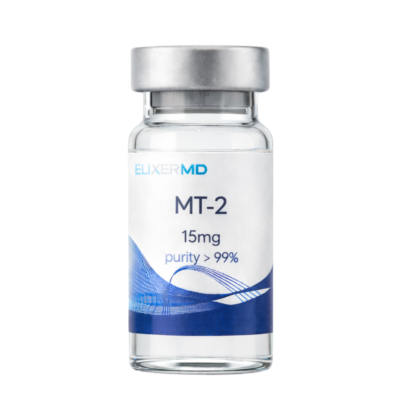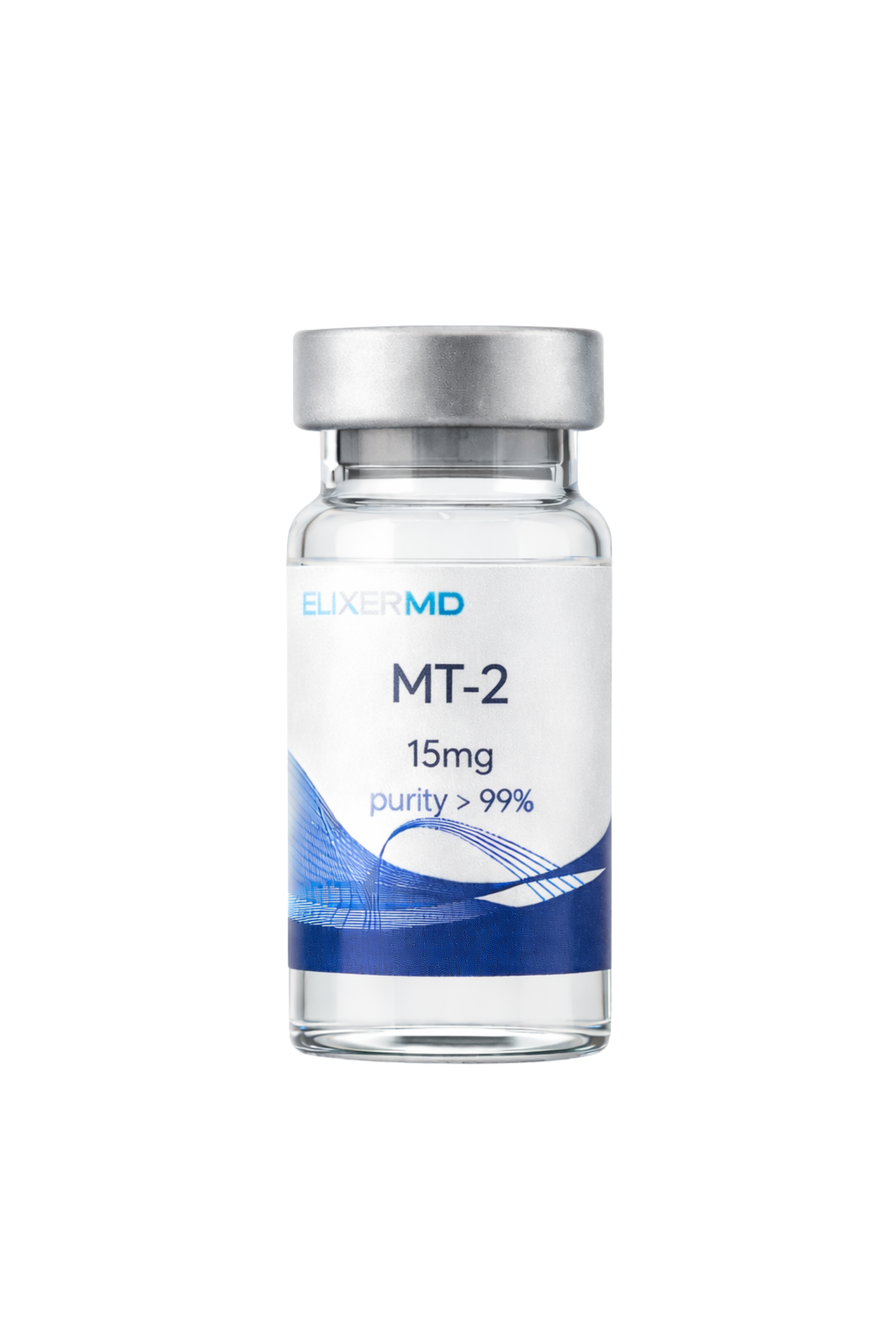
MT-2 (15mg) Research Peptide
$50.00
Melanotan II (MT-2) is a synthetic analog of the α-Melanocyte Stimulating Hormone (α-MSH) designed to activate melanocortin receptors. It is widely studied for its role in pigmentation, receptor signaling, and energy homeostasis. MT-2 provides a valuable model for exploring cellular photoprotection, melanin synthesis, and peptide-receptor interactions.
In stock
Additional info
Introduction
Melanotan II (MT-2) is a synthetic cyclic heptapeptide analog of α-MSH that binds with high affinity to melanocortin receptors, particularly MC1R and MC4R. This dual receptor interaction enables MT-2 to be used in research involving pigmentation biology, receptor signaling, and neuroendocrine regulation. In vitro studies utilize MT-2 to analyze melanogenesis pathways, cyclic AMP (cAMP) signaling cascades, and cell-level mechanisms involved in skin photoprotection and energy balance.
Stability and Bioavailability
MT-2 is characterized by its cyclic structure, which enhances stability and resistance to enzymatic breakdown compared to linear peptide analogs. This makes it particularly effective for extended receptor-binding studies in controlled laboratory settings. When properly stored, MT-2 maintains its conformational integrity and receptor activation capability, supporting reproducible results in melanocortin research models.
Research Applications
Melanocortin Receptor Activation and Pigmentation Studies
MT-2 acts as a potent agonist of the melanocortin-1 receptor (MC1R), which regulates melanin synthesis in melanocytes. It is frequently used in pigmentation and photobiology research to examine cAMP-dependent melanin pathways and cellular defense responses against UV-induced oxidative stress.
Energy Homeostasis and Appetite Regulation
Beyond pigmentation studies, MT-2 interacts with the MC4R receptor, a target associated with appetite and energy regulation. In vitro research investigates MT-2’s effects on hypothalamic receptor signaling and peptide-mediated neuronal communication.
DNA Protection and Cellular Stress Response
MT-2’s role in enhancing melanin production provides a photoprotective effect in cell models, allowing researchers to examine its potential to mitigate UV-related DNA damage and cellular oxidative stress.
Anti-Inflammatory Signaling Pathways
Studies also explore MT-2’s capacity to regulate inflammatory cytokines through melanocortin receptor activation, offering insight into cellular mechanisms of immune modulation and stress adaptation.
Summary
Melanotan II (MT-2) is a highly stable and selective analog of α-MSH that serves as a key research compound in pigmentation, receptor signaling, and photoprotection studies. Its dual receptor activity (MC1R and MC4R) makes it a versatile peptide for exploring both skin pigmentation and neuroendocrine pathways in vitro.
References
-
Abdel-Malek ZA et al., The melanocortin 1 receptor and the UV response of human melanocytes–a shift in paradigm, Photochem Photobiol. (2008). PubMed
-
Hruby VJ et al., Design of novel melanocortin receptor ligands: multiple receptors, complex pharmacology, the challenge, Eur J Pharmacol. (2011). PubMed
-
Cone RD et al., Studies on the physiological functions of the melanocortin system, Endocrine Reviews (2006). PubMed
-
Wang W et al., Melanocortin Regulation of Inflammation, Front Endocrinol. (2018). PubMed
ALL ARTICLES AND PRODUCT INFORMATION PROVIDED ON THIS WEBSITE ARE FOR INFORMATIONAL AND EDUCATIONAL PURPOSES ONLY.
The products offered on this website are furnished for in-vitro studies only. In-vitro studies (Latin: in glass) are performed outside of the body. These products are not medicines or drugs and have not been approved by the FDA to prevent, treat, or cure any medical condition, ailment, or disease. Bodily introduction of any kind into humans or animals is strictly forbidden by law.
Storage Instructions
All peptides are manufactured using lyophilization (freeze-drying), a process that protects product integrity during shipping and storage. This ensures that peptides remain stable for 3–4 months while in their lyophilized form.
Once reconstituted (mixed with bacteriostatic water), peptides should be stored in the refrigerator and will remain stable for up to 30 days.
Lyophilized peptides (unmixed powder) can be kept at room temperature for short-term storage but should ideally be refrigerated under 4°C (39°F) to maintain stability. For long-term preservation (several months to years), peptides should be stored in a freezer at -20°C to -80°C (-4°F to -112°F).
Proper storage helps maintain purity and quality, ensuring your peptides are reliable for research use.
More Peptides:
-
$50.00
 Select options This product has multiple variants. The options may be chosen on the product page
 -
$15.00
-
$220.00