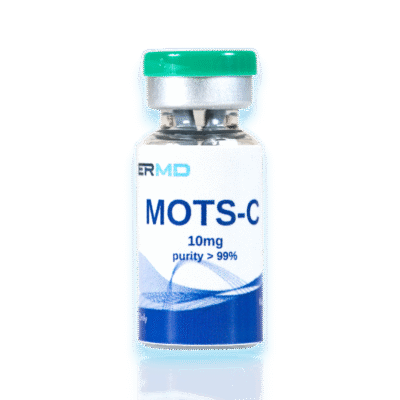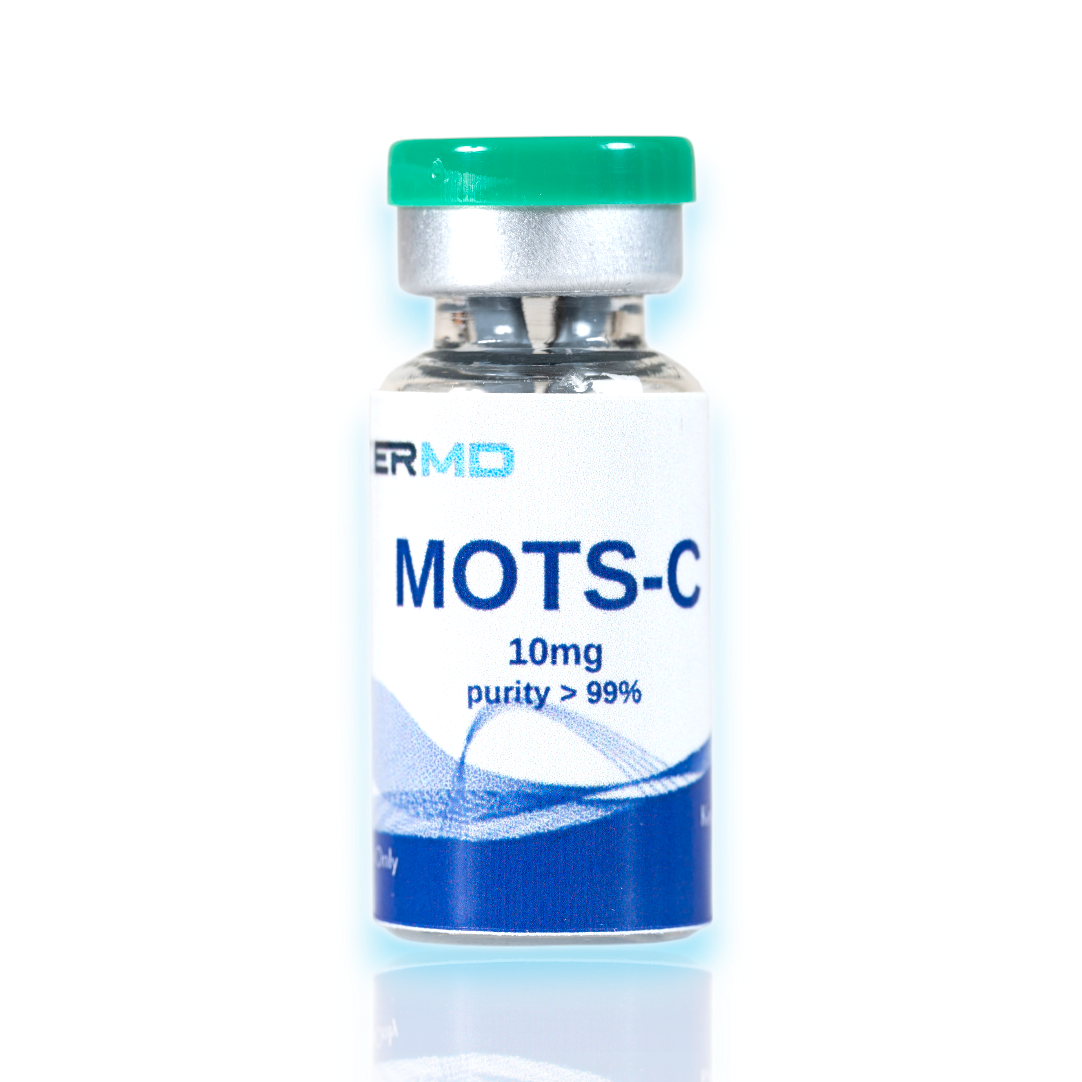
MOTS-C (10mg)
$60.00
MOTS-c is a mitochondrial-derived peptide (MDP) encoded within mitochondrial DNA and studied for its role in regulating cellular metabolism, energy balance, and mitochondrial signaling. Research indicates its involvement in activating AMPK pathways and improving metabolic homeostasis in vitro. MOTS-c has become a focus of interest in cellular energy, oxidative balance, and metabolic adaptation studies.
In stock
Additional info
Introduction
MOTS-c (Mitochondrial Open Reading Frame of the 12S rRNA type-c) is a 16-amino acid peptide encoded by mitochondrial DNA. It has been identified as a key regulator of cellular metabolism, acting through the AMP-activated protein kinase (AMPK) pathway to enhance glucose utilization and mitochondrial efficiency. As a mitochondrial-derived peptide, MOTS-c bridges communication between the mitochondria and nucleus, influencing gene expression and cellular adaptation to metabolic stress.
Stability and Bioavailability
MOTS-c exhibits excellent solubility and thermal stability under laboratory conditions. Its compact peptide structure enables consistent reproducibility across multiple in-vitro model systems. Research indicates that MOTS-c maintains functional integrity in oxidative and metabolic stress environments, making it ideal for long-term cellular energy studies.
Research Applications
Mitochondrial and Metabolic Regulation
MOTS-c has been shown to activate AMPK signaling, a central regulator of cellular energy homeostasis. This activation enhances glucose uptake and fatty acid oxidation, providing insights into the interplay between mitochondrial signaling and cellular energy control.
Oxidative Stress and Cellular Longevity
Studies suggest that MOTS-c contributes to oxidative stress resistance by improving mitochondrial function and reducing reactive oxygen species (ROS) production. Its potential to stabilize mitochondrial dynamics makes it valuable in research related to cellular aging and redox biology.
Metabolic Adaptation and Exercise Response
Experimental data show that MOTS-c expression increases in response to metabolic stress and exercise, suggesting a regulatory feedback mechanism between mitochondrial peptides and nuclear-encoded metabolic genes. This positions MOTS-c as a promising peptide for understanding cellular adaptation and mitochondrial biogenesis in energy-intensive systems.
Summary
MOTS-c is a mitochondria-encoded peptide with emerging significance in metabolic regulation and cellular energy research. Its effects on AMPK activation, oxidative balance, and mitochondrial resilience make it an essential tool for exploring the communication pathways between mitochondrial function and systemic energy homeostasis.
References
-
Lee C et al., The mitochondrial-derived peptide MOTS-c promotes metabolic homeostasis and reduces obesity and insulin resistance, Cell Metabolism (2015). PubMed
-
Reynolds JC et al., MOTS-c is an exercise-induced mitochondrial-encoded regulator of age-dependent physical decline and muscle homeostasis, Nat Commun (2021). PubMed
-
Kim KH et al., The Mitochondrial-Encoded Peptide MOTS-c Translocates to the Nucleus to Regulate Nuclear Gene Expression in Response to Metabolic Stress, Cell Metab (2018). PubMed
-
Woodhead JST et al., Mitochondrial-derived peptides and exercise, Biochim Biophys Acta Gen Subj. (2021). PubMed
ALL ARTICLES AND PRODUCT INFORMATION PROVIDED ON THIS WEBSITE ARE FOR INFORMATIONAL AND EDUCATIONAL PURPOSES ONLY.
The products offered on this website are furnished for in-vitro studies only. In-vitro studies (Latin: in glass) are performed outside of the body. These products are not medicines or drugs and have not been approved by the FDA to prevent, treat, or cure any medical condition, ailment, or disease. Bodily introduction of any kind into humans or animals is strictly forbidden by law.
Storage Instructions
All peptides are manufactured using lyophilization (freeze-drying), a process that protects product integrity during shipping and storage. This ensures that peptides remain stable for 3–4 months while in their lyophilized form.
Once reconstituted (mixed with bacteriostatic water), peptides should be stored in the refrigerator and will remain stable for up to 30 days.
Lyophilized peptides (unmixed powder) can be kept at room temperature for short-term storage but should ideally be refrigerated under 4°C (39°F) to maintain stability. For long-term preservation (several months to years), peptides should be stored in a freezer at -20°C to -80°C (-4°F to -112°F).
Proper storage helps maintain purity and quality, ensuring your peptides are reliable for research use.
More Peptides:
-
$50.00
 Select options This product has multiple variants. The options may be chosen on the product page
 -
$15.00

-
$220.00