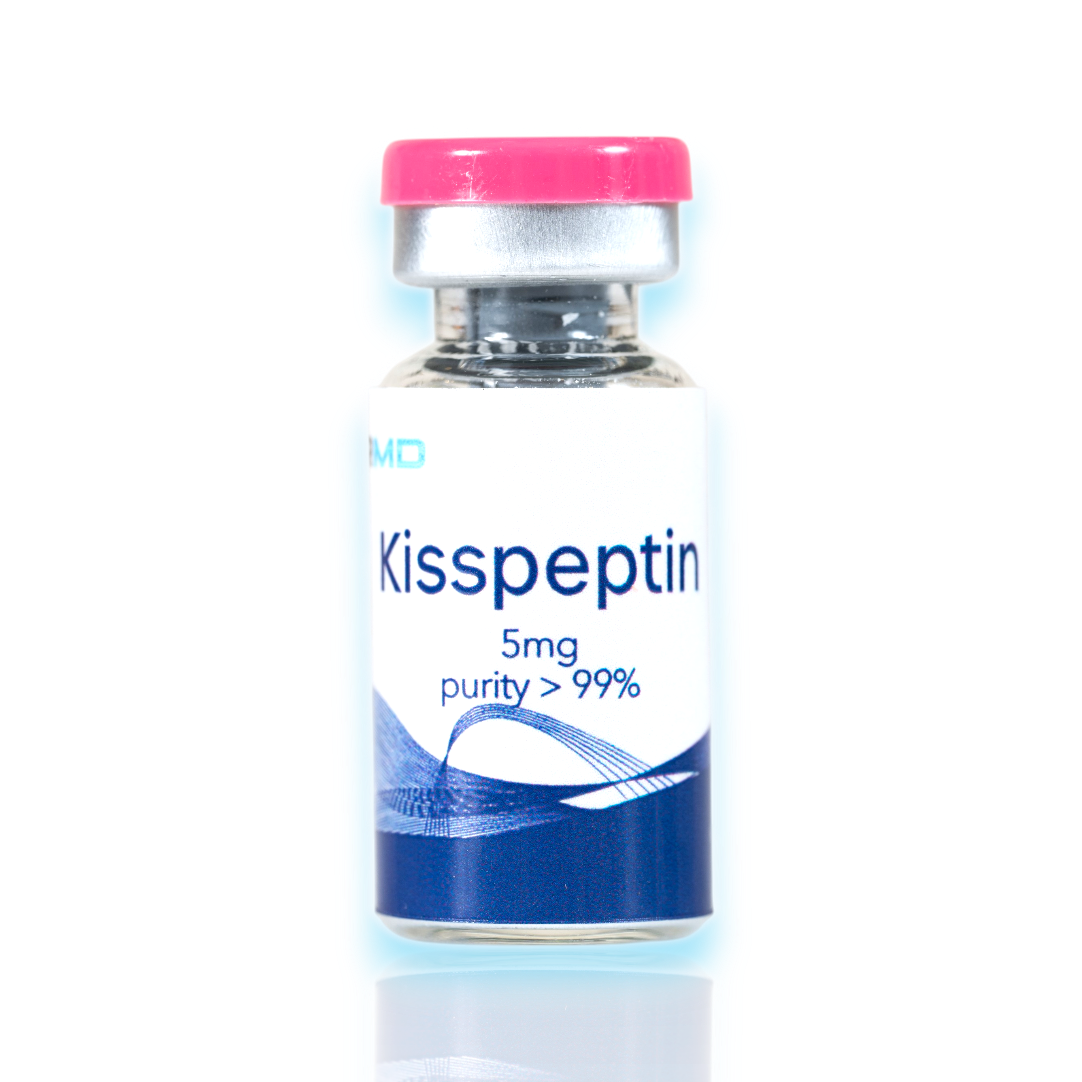
Kisspeptin (5mg)
$50.00
Kisspeptin is a naturally occurring peptide encoded by the KISS1 gene, recognized for its key role in regulating the hypothalamic–pituitary–gonadal (HPG) axis. It is widely studied for its influence on reproductive hormone signaling, neuroendocrine control, and tumor metastasis suppression. Kisspeptin serves as a fundamental research tool in reproductive biology and endocrine studies.
In stock
Additional info
Introduction
Kisspeptin is a neuropeptide belonging to the RF-amide peptide family, first identified as a metastasis suppressor and later recognized as a central regulator of the reproductive hormone cascade. Encoded by the KISS1 gene, Kisspeptin binds to the GPR54 (KISS1R) receptor to stimulate the release of gonadotropin-releasing hormone (GnRH) from the hypothalamus. This discovery has made Kisspeptin essential in studying puberty onset, fertility, and reproductive neuroendocrinology.
Stability and Bioavailability
Kisspeptin peptides, including Kisspeptin-10 and Kisspeptin-54, exhibit high receptor selectivity and stability in in-vitro environments. Their short amino acid sequence enables efficient receptor binding and signal transduction while maintaining consistent molecular activity. Synthetic analogs of Kisspeptin are engineered to improve half-life and binding affinity, providing reproducible results in cellular and molecular experiments.
Research Applications
Reproductive Hormone Regulation
Kisspeptin plays a critical role in stimulating GnRH neurons, which in turn regulate luteinizing hormone (LH) and follicle-stimulating hormone (FSH) release. Researchers use Kisspeptin to study the neuroendocrine control of puberty, ovulation, and gonadal function.
Fertility and Hypothalamic Studies
Due to its direct interaction with the hypothalamic–pituitary–gonadal axis, Kisspeptin is used in research exploring fertility disorders, hypothalamic signaling, and reproductive hormone feedback mechanisms. It has become a benchmark compound for studying sex hormone regulation in both male and female models.
Oncology and Metastasis Suppression
Originally named metastin, Kisspeptin was identified for its role in inhibiting cancer metastasis. It modulates tumor cell migration and invasion through the suppression of matrix metalloproteinases (MMPs), making it relevant in cancer signaling and metastasis-related studies.
Summary
Kisspeptin continues to be a cornerstone peptide in reproductive and endocrine research. Its strong binding affinity for GPR54 and its role in regulating GnRH secretion make it indispensable for exploring fertility, neuroendocrine signaling, and tumor biology. The peptide’s reproducibility and well-characterized receptor mechanisms have made it one of the most widely studied neuropeptides in modern molecular research.
References
-
Seminara SB et al., The GPR54 gene as a regulator of puberty, New England Journal of Medicine (2003). PubMed
-
Oakley AE et al., Kisspeptin signaling in the brain, Endocrine Reviews (2009). PubMed
-
Muir AI et al., AXOR12, a novel human G protein-coupled receptor, activated by the peptide KiSS-1, Journal of Biological Chemistry (2001). PubMed
-
Nagai K et al., Prognostic value of metastin expression in human pancreatic cancer, Journal of Experimental & Clinical Cancer Research (2009). PubMed
ALL ARTICLES AND PRODUCT INFORMATION PROVIDED ON THIS WEBSITE ARE FOR INFORMATIONAL AND EDUCATIONAL PURPOSES ONLY.
The products offered on this website are furnished for in-vitro studies only. In-vitro studies (Latin: in glass) are performed outside of the body. These products are not medicines or drugs and have not been approved by the FDA to prevent, treat, or cure any medical condition, ailment, or disease. Bodily introduction of any kind into humans or animals is strictly forbidden by law.
Storage Instructions
All peptides are manufactured using lyophilization (freeze-drying), a process that protects product integrity during shipping and storage. This ensures that peptides remain stable for 3–4 months while in their lyophilized form.
Once reconstituted (mixed with bacteriostatic water), peptides should be stored in the refrigerator and will remain stable for up to 30 days.
Lyophilized peptides (unmixed powder) can be kept at room temperature for short-term storage but should ideally be refrigerated under 4°C (39°F) to maintain stability. For long-term preservation (several months to years), peptides should be stored in a freezer at -20°C to -80°C (-4°F to -112°F).
Proper storage helps maintain purity and quality, ensuring your peptides are reliable for research use.
More Peptides:
-
$50.00
 Select options This product has multiple variants. The options may be chosen on the product page
 -
$15.00
-
$220.00