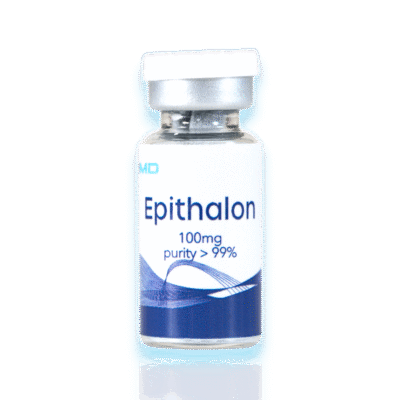
Epithalon (100mg)
$290.00
Epithalon is a synthetic tetrapeptide derived from epithalamin, a naturally occurring peptide isolated from the pineal gland. It has been extensively researched for its role in regulating telomerase activity, cellular aging, and circadian rhythm synchronization in laboratory models. Studies indicate potential effects on oxidative balance and DNA repair pathways, making Epithalon a valuable compound in longevity and cellular biology research.
In stock
Additional info
Introduction
Epithalon (also referred to as Epitalon or Epithalamin) is a synthetic analog of a naturally occurring peptide secreted by the pineal gland. Originally developed at the St. Petersburg Institute of Bioregulation and Gerontology, Epithalon has been studied for its ability to activate telomerase, stabilize telomere length, and influence the expression of genes associated with circadian rhythm and oxidative defense. Its primary research significance lies in its association with the biology of aging and genome protection.
Stability and Bioavailability
Epithalon demonstrates high stability and solubility under laboratory conditions, which allows for reliable replication of results in cellular and biochemical research. Its small molecular size contributes to efficient diffusion and absorption in in-vitro environments. Research has noted consistent peptide activity across multiple model systems, including human fibroblast and murine studies, making it a strong candidate for cellular longevity and genomic preservation investigations.
Research Applications
Telomerase Activation and Genomic Stability
Epithalon has been shown to activate telomerase, the enzyme responsible for extending telomeres—the protective caps of chromosomes. This process has been linked to delayed cellular senescence and improved genomic stability in experimental models, suggesting utility in studies of cellular aging and DNA maintenance.
Antioxidant and Anti-Aging Mechanisms
Studies indicate that Epithalon may help modulate oxidative stress by influencing the expression of antioxidant enzymes such as superoxide dismutase. This supports its research relevance in understanding how peptides may impact redox balance and mitochondrial health in vitro.
Circadian Rhythm and Endocrine Regulation
Epithalon has been studied for its potential to normalize melatonin secretion and synchronize circadian cycles. Experimental data suggest that it may regulate neuroendocrine activity, furthering interest in its role in circadian rhythm research and pineal gland function.
Summary
Epithalon is a synthetic peptide widely studied for its effects on telomere maintenance, oxidative stress modulation, and circadian rhythm regulation. Its robust molecular stability and reproducible experimental outcomes have made it a cornerstone in research on cellular aging, genomic protection, and bioregulatory peptide science.
References
-
Khavinson V et al., Peptide regulation of aging: Epithalamin and Epithalon studies, Biogerontology (2003). PubMed
-
Anisimov VN et al., Effect of Epithalon on biomarkers of aging and lifespan in mice and rats, Neuroendocrinology Letters (2003). PubMed
-
Arutjunyan AV et al., Effect of pineal peptide Epithalon on oxidative stress and mitochondrial function, Bulletin of Experimental Biology and Medicine (2001). PubMed
-
Khavinson VK et al., Epithalon peptide induces telomerase activity and telomere elongation in human somatic cells, Rejuvenation Research (2003). PubMed
ALL ARTICLES AND PRODUCT INFORMATION PROVIDED ON THIS WEBSITE ARE FOR INFORMATIONAL AND EDUCATIONAL PURPOSES ONLY.
The products offered on this website are furnished for in-vitro studies only. In-vitro studies (Latin: in glass) are performed outside of the body. These products are not medicines or drugs and have not been approved by the FDA to prevent, treat, or cure any medical condition, ailment, or disease. Bodily introduction of any kind into humans or animals is strictly forbidden by law.
Storage Instructions
All peptides are manufactured using lyophilization (freeze-drying), a process that protects product integrity during shipping and storage. This ensures that peptides remain stable for 3–4 months while in their lyophilized form.
Once reconstituted (mixed with bacteriostatic water), peptides should be stored in the refrigerator and will remain stable for up to 30 days.
Lyophilized peptides (unmixed powder) can be kept at room temperature for short-term storage but should ideally be refrigerated under 4°C (39°F) to maintain stability. For long-term preservation (several months to years), peptides should be stored in a freezer at -20°C to -80°C (-4°F to -112°F).
Proper storage helps maintain purity and quality, ensuring your peptides are reliable for research use.
More Peptides:
-
$50.00
 Select options This product has multiple variants. The options may be chosen on the product page
 -
$15.00
-
$220.00