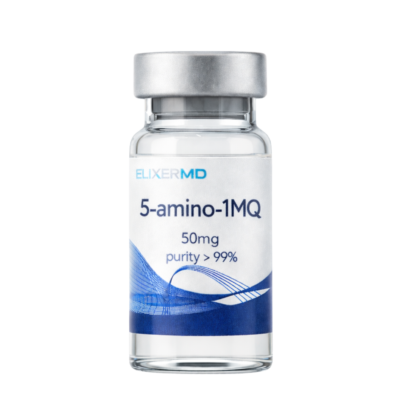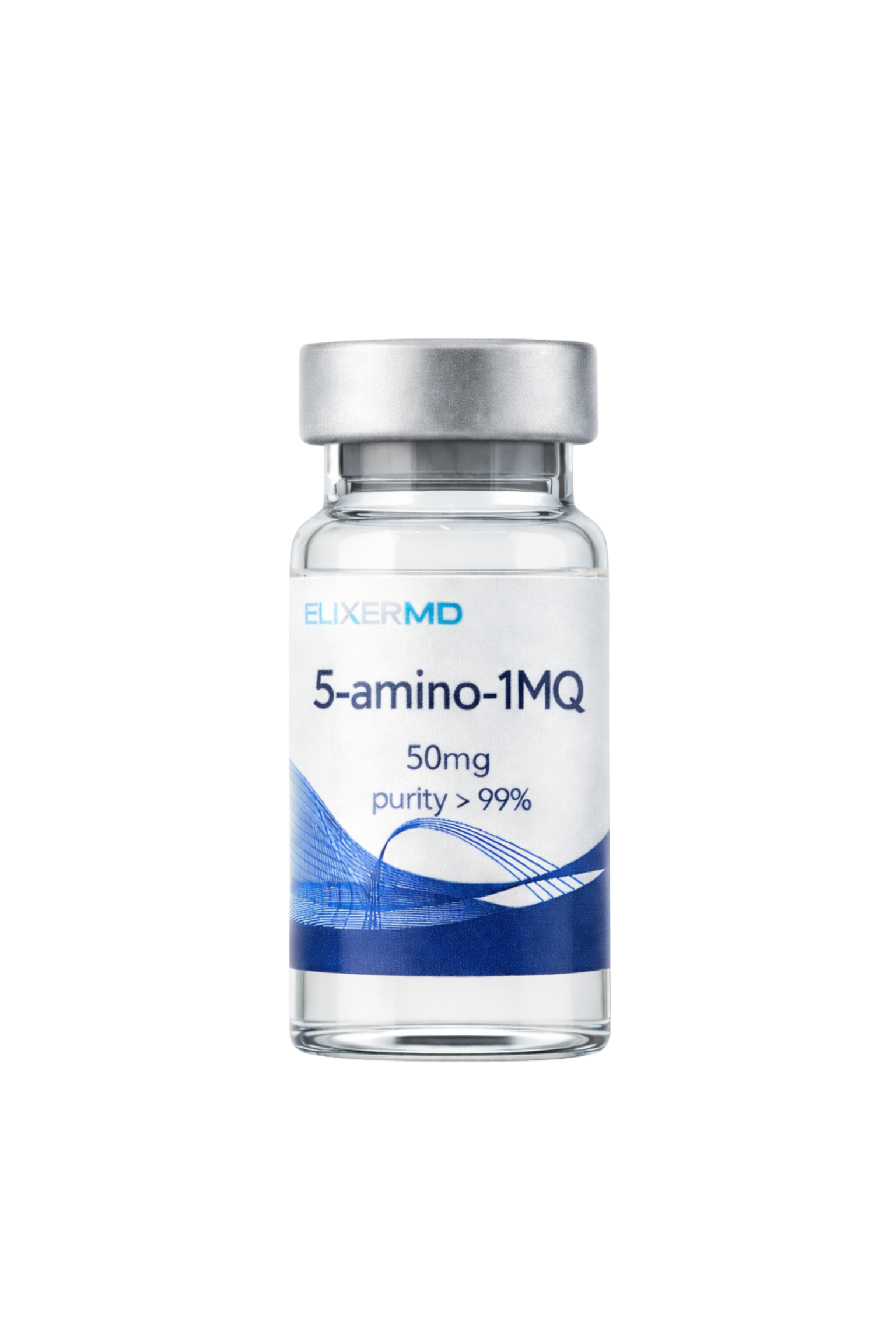
5-amino-1MQ
$220.00
5-Amino-1MQ is a small-molecule compound studied for its role as a selective inhibitor of nicotinamide N-methyltransferase (NNMT). Research involving this compound focuses on cellular metabolism, energy expenditure, and NAD+ pathway regulation. It provides valuable insights into methylation balance and metabolic adaptation mechanisms in vitro.
In stock
Additional info
Introduction
5-Amino-1MQ is a nicotinamide analog that inhibits nicotinamide N-methyltransferase (NNMT), an enzyme responsible for methylating nicotinamide and regulating NAD+ biosynthesis. Through this inhibition, 5-Amino-1MQ supports research exploring cellular energy metabolism, methyl donor balance, and adipocyte function. In vitro, this compound has been used to study how NNMT inhibition impacts NAD+ salvage pathways, S-adenosylmethionine (SAM) turnover, and metabolic regulation at the cellular level.
Stability and Bioavailability
As a small, non-peptidic compound, 5-Amino-1MQ demonstrates high solubility and structural stability in controlled laboratory conditions. It maintains its chemical integrity during extended storage and exposure to cell culture environments, making it a reliable reagent for enzymatic and biochemical pathway analysis.
Research Applications
NNMT Inhibition and Metabolic Studies
5-Amino-1MQ is a selective NNMT inhibitor, allowing researchers to assess how the modulation of this enzyme affects NAD+ metabolism and methyl donor recycling. Studies use it to investigate NNMT’s regulatory role in adipocyte energy storage and cellular thermogenesis.
NAD+ Pathway Regulation
Research utilizing 5-Amino-1MQ provides valuable insights into the NAD+ salvage cycle, a crucial component of cellular redox balance and metabolic efficiency. By inhibiting NNMT, this compound aids in examining NAD+ conservation and its downstream effects on mitochondrial activity.
Methylation and Epigenetic Mechanisms
NNMT activity influences global methylation potential through the consumption of SAM. 5-Amino-1MQ allows for controlled study of this pathway, supporting research on methylation balance, histone modification, and cellular epigenetic regulation.
Adipocyte and Energy Expenditure Models
In vitro models utilize 5-Amino-1MQ to study adipocyte differentiation and energy expenditure, particularly in metabolic research focused on lipid accumulation, mitochondrial respiration, and glucose handling under NNMT inhibition conditions.
Summary
5-Amino-1MQ is a potent small-molecule NNMT inhibitor that offers a reliable model for studying energy metabolism, NAD+ biosynthesis, and methylation processes. Its structural stability and specificity make it a useful tool in biochemical and metabolic pathway research aimed at understanding cellular energy dynamics.
References
-
Kraus D et al., Nicotinamide N-methyltransferase knockdown protects against diet-induced obesity, Nature (2014). PubMed
-
Hong S et al., Nicotinamide N-methyltransferase regulates hepatic nutrient metabolism through Sirt1 protein stabilization, Nat Med. (2013). PubMed
-
Ruf S et al., Novel tricyclic small molecule inhibitors of Nicotinamide N-methyltransferase for the treatment of metabolic disorders, Sci Rep. (2021). PubMed
-
Li JJ et al., Nicotinamide N-Methyltransferase (NNMT): A New Hope for Treating Aging and Age-Related Conditions, Metabolites. (2024). PubMed
ALL ARTICLES AND PRODUCT INFORMATION PROVIDED ON THIS WEBSITE ARE FOR INFORMATIONAL AND EDUCATIONAL PURPOSES ONLY.
The products offered on this website are furnished for in-vitro studies only. In-vitro studies (Latin: in glass) are performed outside of the body. These products are not medicines or drugs and have not been approved by the FDA to prevent, treat, or cure any medical condition, ailment, or disease. Bodily introduction of any kind into humans or animals is strictly forbidden by law.
Storage Instructions
All peptides are manufactured using lyophilization (freeze-drying), a process that protects product integrity during shipping and storage. This ensures that peptides remain stable for 3–4 months while in their lyophilized form.
Once reconstituted (mixed with bacteriostatic water), peptides should be stored in the refrigerator and will remain stable for up to 30 days.
Lyophilized peptides (unmixed powder) can be kept at room temperature for short-term storage but should ideally be refrigerated under 4°C (39°F) to maintain stability. For long-term preservation (several months to years), peptides should be stored in a freezer at -20°C to -80°C (-4°F to -112°F).
Proper storage helps maintain purity and quality, ensuring your peptides are reliable for research use.
More Peptides:
-
$50.00
 Select options This product has multiple variants. The options may be chosen on the product page
 -
$15.00
-
$45.00