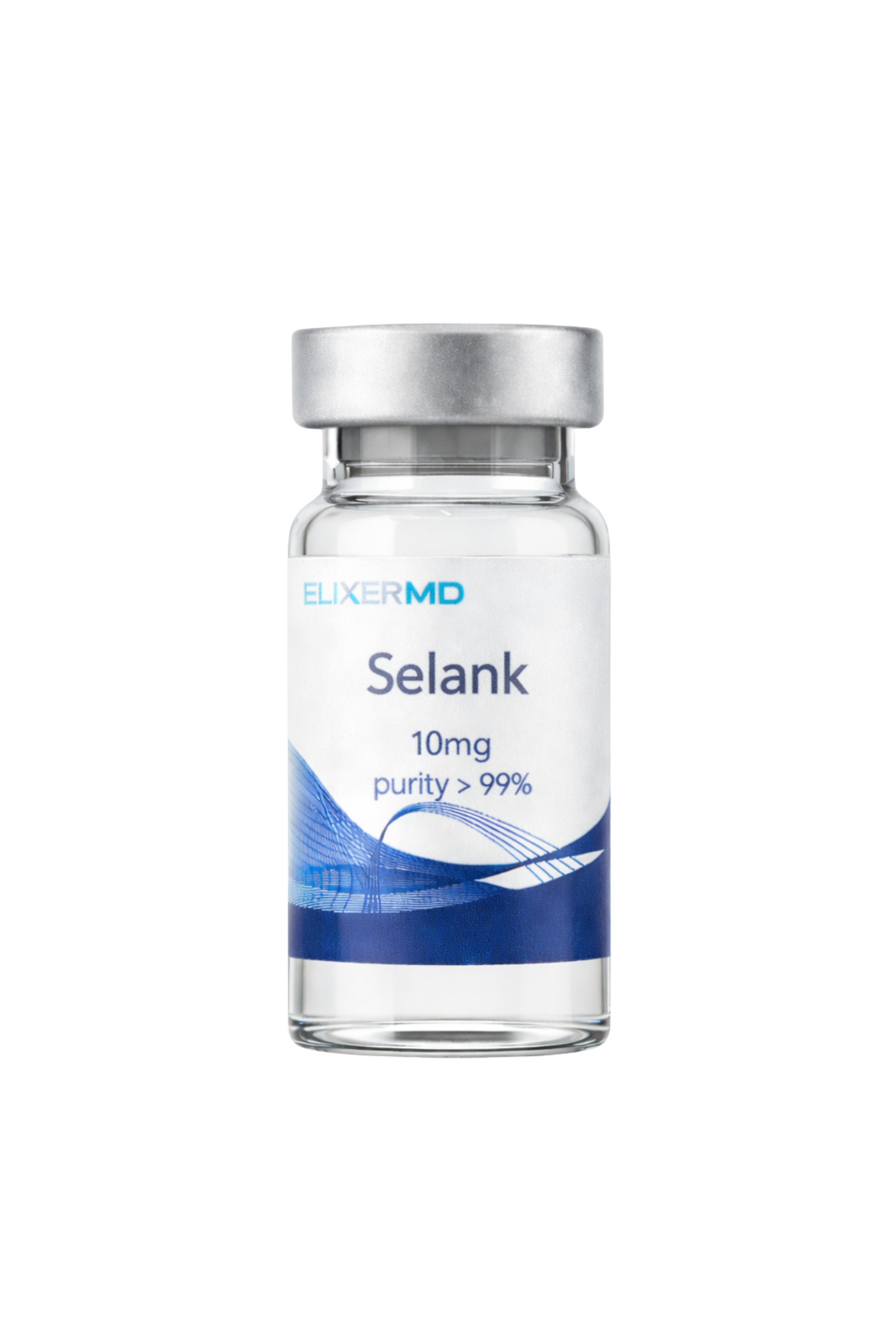
Selank (10mg) Research Peptide
$100.00
Selank is a synthetic peptide derived from the endogenous human tetrapeptide tuftsin. It has been extensively researched for its role in modulating neurotransmitter activity, neuroplasticity, and immune regulation. As a heptapeptide analog, Selank is valued for its high stability and reproducibility in cognitive and neurochemical research settings.
In stock
Additional info
Introduction
Selank is a synthetic analog of tuftsin (Thr-Lys-Pro-Arg), modified to enhance stability and receptor affinity. Originally developed by the Institute of Molecular Genetics of the Russian Academy of Sciences, Selank is classified as an anxiolytic peptide with nootropic and neuromodulatory properties in laboratory settings. Research has explored its influence on neurotransmitter balance, gene expression, and brain-derived neurotrophic factor (BDNF) modulation, making it a popular compound in neurochemical and behavioral studies.
Stability and Bioavailability
Selank exhibits strong molecular stability due to the addition of a Pro-Gly-Pro sequence, which increases resistance to enzymatic degradation. Its high water solubility and predictable in-vitro bioactivity allow for consistent results in neuronal cell culture models and neurochemical assays.
Research Applications
Neurotransmitter Modulation
Selank has been shown to influence monoaminergic systems, particularly serotonin and dopamine levels, in in-vitro and preclinical models. Its ability to stabilize neurotransmitter turnover makes it a valuable research tool in studying the biochemical basis of stress, anxiety, and neuroregulation.
Cognitive Function and Memory Studies
Laboratory studies have demonstrated that Selank may enhance BDNF expression, suggesting a potential role in neuroplasticity and memory formation. These effects have led to its frequent inclusion in research examining learning processes and cognitive adaptability.
Immunomodulatory Research
Derived from tuftsin, a naturally occurring immunomodulatory peptide, Selank has also been studied for its regulatory effects on cytokine activity and immune cell communication. This crossover between neurochemical and immune systems provides a unique research pathway for studying the neuroimmune interface.
Summary
Selank represents a stable and selective neuromodulatory peptide designed to explore the molecular mechanisms underlying cognition, neurotransmitter regulation, and immune response. Its well-documented safety profile in controlled in-vitro studies and high reproducibility make it an ideal peptide for ongoing neurochemical and behavioral research.
References
-
Medvedev VE et al., A comparison of the anxiolytic effect and tolerability of selank and phenazepam in the treatment of anxiety disorders, Zh Nevrol Psikhiatr Im S S Korsakova (2014). PubMed
-
Volkova A et al., Selank Administration Affects the Expression of Some Genes Involved in GABAergic Neurotransmission, Front Pharmacol (2016). PubMed
-
Kolik LG et al., Peptide Analogue of Tuftsin, Protects Against Ethanol-Induced Memory Impairment by Regulating of BDNF Content in the Hippocampus and Prefrontal Cortex in Rats, Bull Exp Biol Med. (2019). PubMed
-
Uchakina ON et al., Immunomodulatory effects of selank in patients with anxiety-asthenic disorders, Zh Nevrol Psikhiatr Im S S Korsakova (2008). PubMed
ALL ARTICLES AND PRODUCT INFORMATION PROVIDED ON THIS WEBSITE ARE FOR INFORMATIONAL AND EDUCATIONAL PURPOSES ONLY.
The products offered on this website are furnished for in-vitro studies only. In-vitro studies (Latin: in glass) are performed outside of the body. These products are not medicines or drugs and have not been approved by the FDA to prevent, treat, or cure any medical condition, ailment, or disease. Bodily introduction of any kind into humans or animals is strictly forbidden by law.
Storage Instructions
All peptides are manufactured using lyophilization (freeze-drying), a process that protects product integrity during shipping and storage. This ensures that peptides remain stable for 3–4 months while in their lyophilized form.
Once reconstituted (mixed with bacteriostatic water), peptides should be stored in the refrigerator and will remain stable for up to 30 days.
Lyophilized peptides (unmixed powder) can be kept at room temperature for short-term storage but should ideally be refrigerated under 4°C (39°F) to maintain stability. For long-term preservation (several months to years), peptides should be stored in a freezer at -20°C to -80°C (-4°F to -112°F).
Proper storage helps maintain purity and quality, ensuring your peptides are reliable for research use.
More Peptides:
-
$50.00
 Select options This product has multiple variants. The options may be chosen on the product page
 -
$15.00
-
$220.00