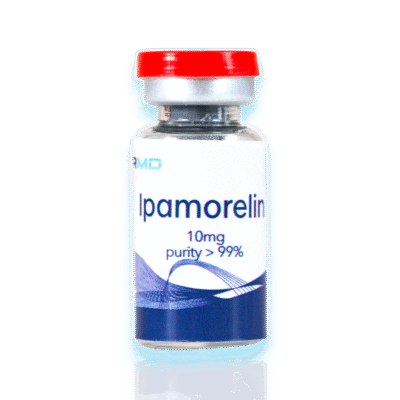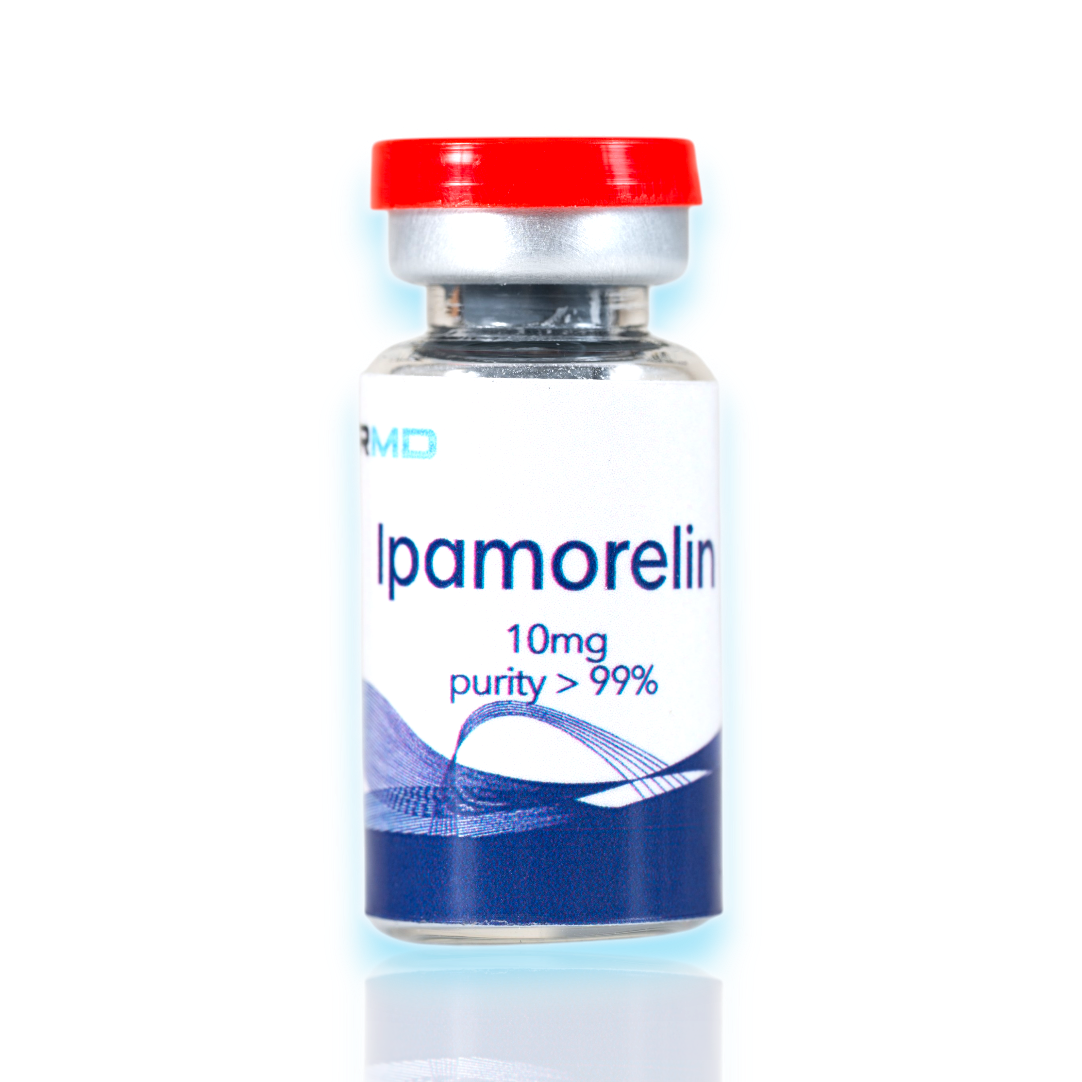
Ipamorelin (10mg)
$50.00
Ipamorelin is a selective growth hormone secretagogue peptide studied for its role in stimulating natural growth hormone (GH) release through ghrelin receptor activation. It is known for its receptor-specific action and minimal effect on cortisol or prolactin levels, making it valuable in research focused on endocrine regulation and peptide signaling.
In stock
Additional info
Introduction
Ipamorelin is a synthetic pentapeptide and selective growth hormone secretagogue (GHS) designed to bind to the ghrelin (GHS-R1a) receptor. Unlike earlier GHS analogs, Ipamorelin demonstrates strong GH-releasing properties with minimal off-target hormonal activity. It is often used in research to study growth hormone pulsatility, pituitary function, and the regulatory mechanisms of the somatotropic axis.
Stability and Bioavailability
Ipamorelin exhibits high stability in aqueous solutions and consistent activity across a wide range of in-vitro environments. Due to its small peptide size and resistance to enzymatic degradation, it maintains reliable bioactivity in controlled research settings. Its clean receptor selectivity and predictable pharmacokinetics make it a benchmark compound in growth hormone-related studies.
Research Applications
Growth Hormone Release and Ghrelin Receptor Studies
Ipamorelin acts as an agonist of the ghrelin receptor (GHS-R1a), triggering pulsatile GH release from the anterior pituitary. Studies have shown that its mechanism mimics natural ghrelin signaling, making it ideal for research into peptide-regulated endocrine modulation.
Metabolic and Anabolic Pathway Research
Through GH stimulation, Ipamorelin indirectly influences metabolic homeostasis and cellular growth pathways. Its activity has been investigated in models studying energy metabolism, protein synthesis, and recovery processes, providing valuable data for endocrine and metabolic research.
Receptor Selectivity and Hormonal Specificity
One of Ipamorelin’s most distinctive research attributes is its selective GH-releasing profile without significantly affecting cortisol or prolactin levels. This makes it a preferred candidate for studying receptor-targeted peptide design and hormonal specificity.
Summary
Ipamorelin remains one of the most selective and well-characterized GH secretagogues available for scientific research. Its high receptor specificity, stable performance, and minimal off-target activity make it an essential peptide in exploring growth hormone modulation, receptor pharmacology, and endocrine system function.
References
-
Raun K et al., Ipamorelin, the first selective growth hormone secretagogue, European Journal of Endocrinology (1998). PubMed
-
Svensson J et al., The GH secretagogues ipamorelin and GH-releasing peptide-6 increase bone mineral content in adult female rats, Journal of Clinical Endocrinology (2000). PubMed
- Raun K et al., Pharmacological characterisation of a new oral GH secretagogue, NN703, Oxford Academic (1999). PubMed
ALL ARTICLES AND PRODUCT INFORMATION PROVIDED ON THIS WEBSITE ARE FOR INFORMATIONAL AND EDUCATIONAL PURPOSES ONLY.
The products offered on this website are furnished for in-vitro studies only. In-vitro studies (Latin: in glass) are performed outside of the body. These products are not medicines or drugs and have not been approved by the FDA to prevent, treat, or cure any medical condition, ailment, or disease. Bodily introduction of any kind into humans or animals is strictly forbidden by law.
Storage Instructions
All peptides are manufactured using lyophilization (freeze-drying), a process that protects product integrity during shipping and storage. This ensures that peptides remain stable for 3–4 months while in their lyophilized form.
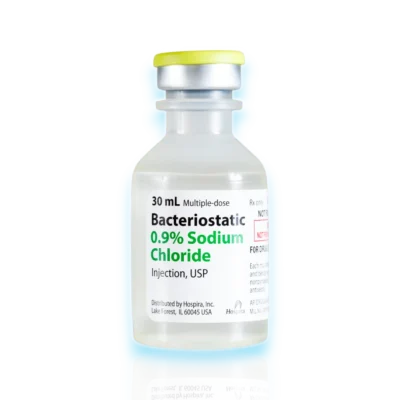
Once reconstituted (mixed with bacteriostatic water), peptides should be stored in the refrigerator and will remain stable for up to 30 days.
Lyophilized peptides (unmixed powder) can be kept at room temperature for short-term storage but should ideally be refrigerated under 4°C (39°F) to maintain stability. For long-term preservation (several months to years), peptides should be stored in a freezer at -20°C to -80°C (-4°F to -112°F).
Proper storage helps maintain purity and quality, ensuring your peptides are reliable for research use.
More Peptides:
-
$50.00
 Select options This product has multiple variants. The options may be chosen on the product page
 -
$15.00
-
$220.00