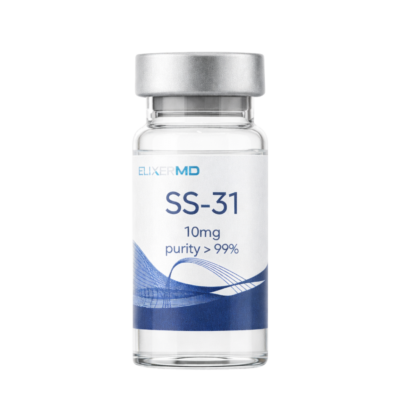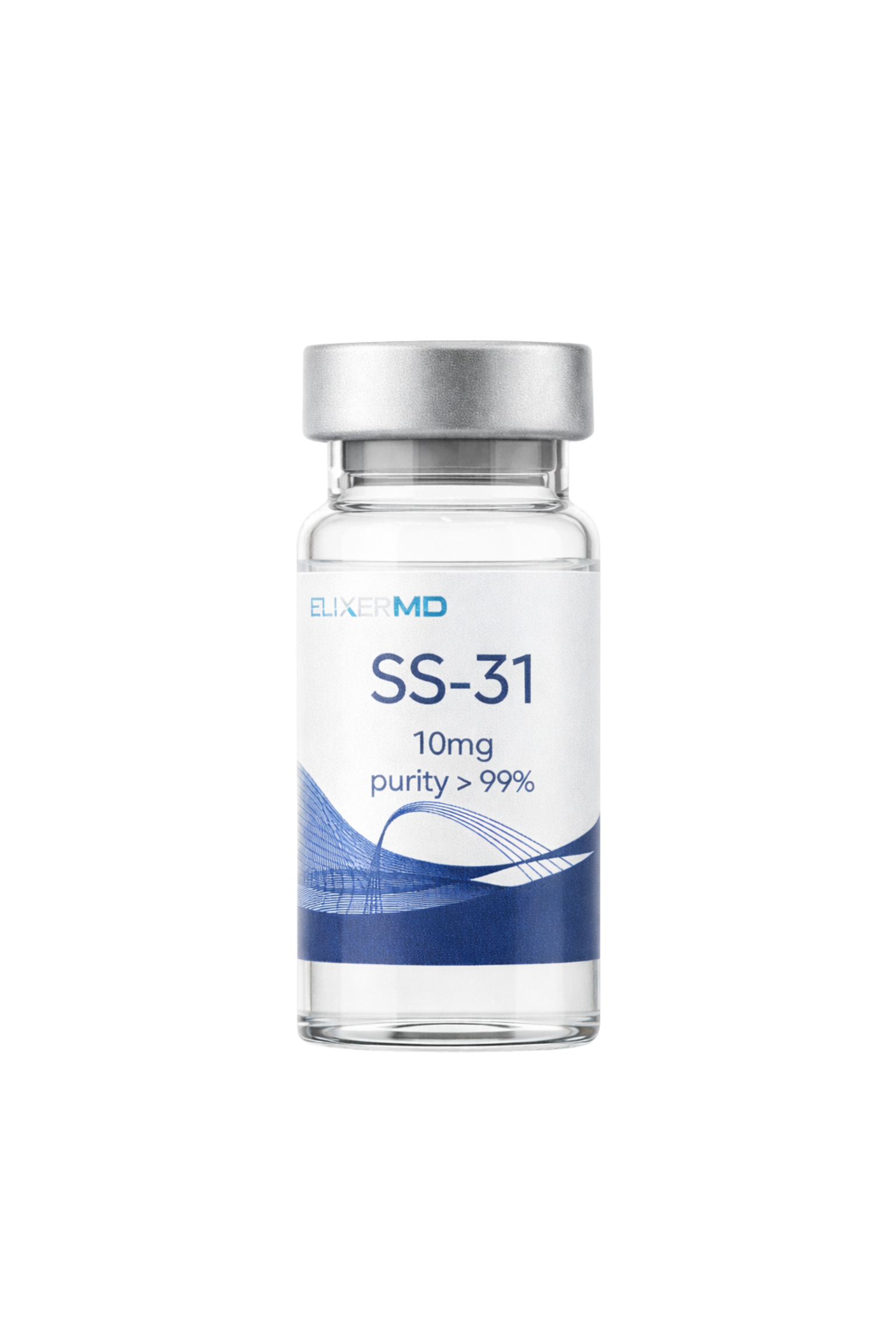
SS-31 (10mg) Research Peptide
$60.00
SS-31, also known as Elamipretide, is a mitochondria-targeted tetrapeptide that has been widely studied for its ability to preserve mitochondrial integrity and reduce oxidative stress. Research indicates its potential role in stabilizing cardiolipin and enhancing mitochondrial bioenergetics. SS-31 continues to serve as a valuable tool in exploring mitochondrial dysfunction, cellular aging, and oxidative damage in preclinical studies.
In stock
Additional info
Introduction
SS-31 (Elamipretide) is a synthetic tetrapeptide (D-Arg-Dmt-Lys-Phe-NH₂) specifically designed to target and interact with cardiolipin, a unique phospholipid found in the inner mitochondrial membrane. This interaction stabilizes mitochondrial structure and function, reducing reactive oxygen species (ROS) production and promoting efficient ATP synthesis. SS-31 has been extensively investigated for its potential to mitigate mitochondrial dysfunction, a hallmark of aging and various degenerative conditions, making it a cornerstone compound in mitochondrial and cellular bioenergetics research.
Stability and Bioavailability
SS-31 demonstrates high solubility and resistance to enzymatic degradation, allowing for consistent behavior in laboratory settings. Its small molecular weight enables rapid diffusion and intracellular penetration, while its affinity for cardiolipin ensures targeted mitochondrial localization. These characteristics make SS-31 an ideal candidate for long-term cell culture studies and in-vitro models focusing on mitochondrial health and oxidative balance.
Research Applications
Mitochondrial Protection and Bioenergetics
Studies have shown that SS-31 binds selectively to cardiolipin, stabilizing the inner mitochondrial membrane and preventing cytochrome c peroxidase activity. This leads to reduced oxidative stress and improved ATP generation, supporting its use in research on mitochondrial resilience and cellular energy metabolism.
Oxidative Stress and Apoptosis Regulation
SS-31 has demonstrated the ability to lower mitochondrial ROS levels and protect against oxidative damage in multiple cell types. Its effects on apoptotic pathways make it valuable for research into mechanisms of cell survival, neuroprotection, and redox balance.
Cardiac and Skeletal Muscle Research
Preclinical findings have highlighted SS-31’s potential to improve mitochondrial function in cardiac and skeletal muscle tissues. Researchers utilize this peptide to study mitochondrial bioenergetics in the context of energy-demanding systems and metabolic stress.
Summary
SS-31 (Elamipretide) remains one of the most prominent peptides in mitochondrial research due to its selective cardiolipin-binding properties and broad effects on mitochondrial bioenergetics. Its combination of molecular stability, cellular permeability, and antioxidant potential positions it as a critical reference compound for studying oxidative stress, mitochondrial disorders, and cellular aging in vitro.
References
- Szeto HH et al., SS-31: A mitochondria-targeted peptide for reducing oxidative stress and improving mitochondrial bioenergetics, FASEB Journal (2008). https://doi.org/10.1096/fj.07-101824
- Birk AV et al., The mitochondrial-targeted compound SS-31 re-energizes ischemic mitochondria and protects the heart from ischemia–reperfusion injury, Journal of the American Heart Association (2014). https://doi.org/10.1161/JAHA.114.001015
- Zhao K et al., Cell-permeable peptide antioxidants targeted to inner mitochondrial membrane inhibit mitochondrial swelling and oxidative cell death, Journal of Biological Chemistry (2004). https://doi.org/10.1074/jbc.M404788200
- Szeto HH, First-in-class cardiolipin-protective compound Elamipretide in mitochondrial medicine, Nature Reviews Drug Discovery (2014). https://doi.org/10.1038/nrd4481
ALL ARTICLES AND PRODUCT INFORMATION PROVIDED ON THIS WEBSITE ARE FOR INFORMATIONAL AND EDUCATIONAL PURPOSES ONLY.
The products offered on this website are furnished for in-vitro studies only. In-vitro studies (Latin: in glass) are performed outside of the body. These products are not medicines or drugs and have not been approved by the FDA to prevent, treat, or cure any medical condition, ailment, or disease. Bodily introduction of any kind into humans or animals is strictly forbidden by law.
Storage Instructions
All peptides are manufactured using lyophilization (freeze-drying), a process that protects product integrity during shipping and storage. This ensures that peptides remain stable for 3–4 months while in their lyophilized form.
Once reconstituted (mixed with bacteriostatic water), peptides should be stored in the refrigerator and will remain stable for up to 30 days.
Lyophilized peptides (unmixed powder) can be kept at room temperature for short-term storage but should ideally be refrigerated under 4°C (39°F) to maintain stability. For long-term preservation (several months to years), peptides should be stored in a freezer at -20°C to -80°C (-4°F to -112°F).
Proper storage helps maintain purity and quality, ensuring your peptides are reliable for research use.
More Peptides:
-
$50.00
 Select options This product has multiple variants. The options may be chosen on the product page
 -
$15.00
-
$220.00