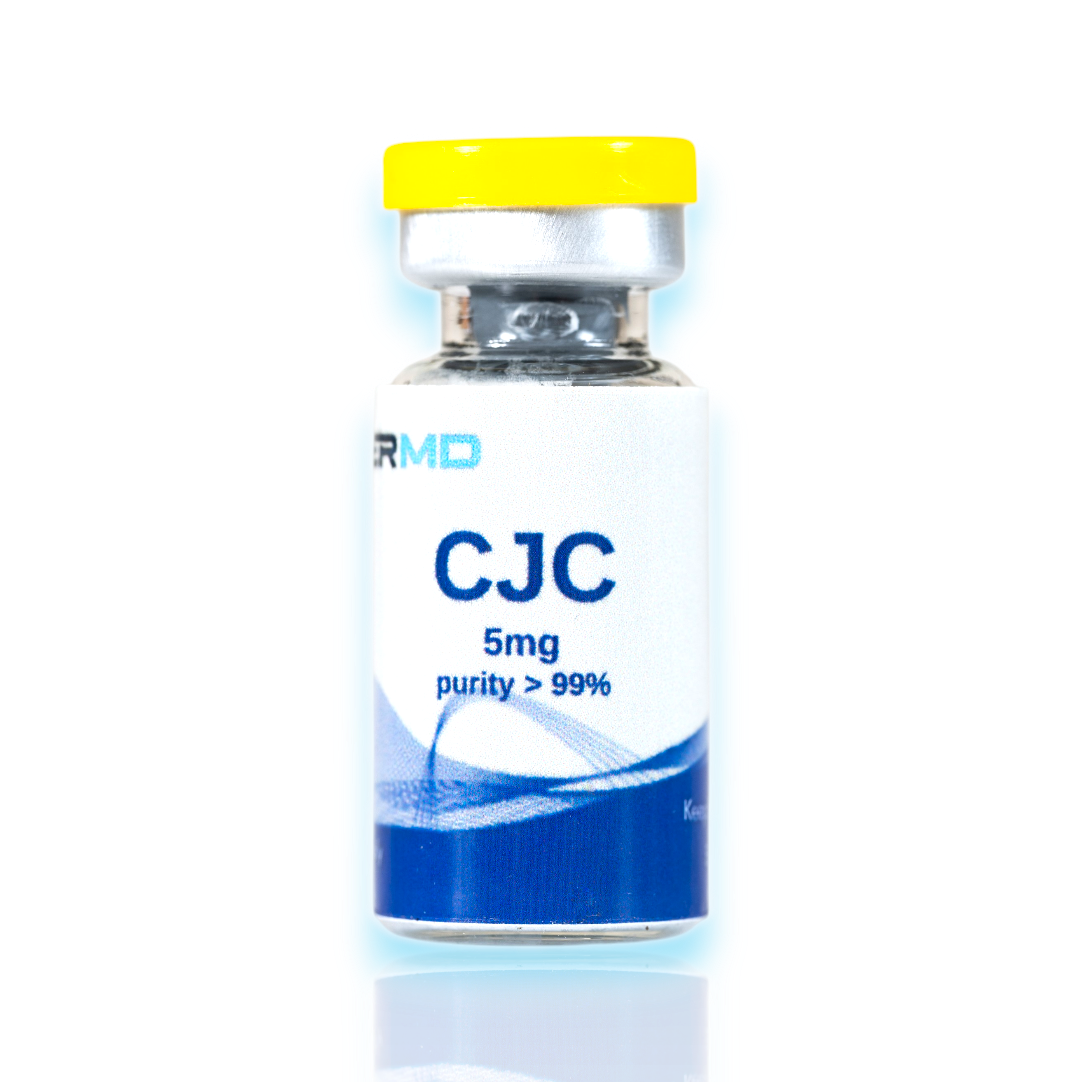
CJC 1295 (5mg)
$50.00
CJC-1295 is a synthetic peptide analog of growth hormone-releasing hormone (GHRH), designed for extended half-life and stability. Research has examined its effects on stimulating growth hormone secretion and regulating metabolic pathways. Its ability to bind to albumin extends its activity, making it a reliable candidate for laboratory studies. CJC-1295 is commonly studied in connection with endocrine and metabolic research.
In stock
Additional info
Introduction
CJC-1295 is a synthetic analog of growth hormone-releasing hormone (GHRH) that incorporates modifications allowing it to bind to serum albumin, significantly extending its half-life compared to native GHRH. Research has focused on its ability to promote sustained growth hormone release, improve metabolic regulation, and act as a model for endocrine peptide stability in preclinical settings.
Stability and Bioavailability
CJC-1295 demonstrates enhanced stability and extended bioavailability due to its ability to bind to circulating albumin. This structural modification prevents rapid degradation, allowing for longer activity in vivo experimental models. The stability of CJC-1295 makes it valuable for studying long-term effects of growth hormone modulation in research environments.
Research Applications
Endocrine and Growth Hormone Regulation
Preclinical studies suggest CJC-1295 effectively stimulates sustained secretion of growth hormone and insulin-like growth factor 1 (IGF-1). This prolonged activity differentiates it from shorter-acting analogs, making it an important tool for endocrine system research.
Metabolic Research
CJC-1295 has been studied for its role in regulating metabolism, with evidence pointing toward improved lipid and glucose balance in animal models. Research has also highlighted its potential for long-term modulation of energy expenditure.
Tissue Regeneration and Repair
Experimental studies indicate that growth hormone modulation through peptides like CJC-1295 may indirectly support tissue repair, collagen synthesis, and cellular recovery mechanisms, providing a broader framework for regenerative research.
Summary
CJC-1295 is a long-acting GHRH analog that has been widely studied for its influence on growth hormone release and metabolic pathways. With strong stability, extended bioavailability, and consistent research outcomes, it remains an important peptide for laboratory investigations into endocrine and regenerative processes.
References
-
Teichman SL et al., Prolonged stimulation of growth hormone (GH) and insulin-like growth factor I secretion by CJC-1295, a long-acting analog of GH-releasing hormone, in healthy adults, Journal of Clinical Endocrinology & Metabolism (2006). PubMed
-
Sackmann-Sala L et al., Activation of the GH/IGF-1 axis by CJC-1295, a long acting GHRH analog, results in serum protein profile changes in normal adult subjects, Growth Hormone & IGF Research (2009). PubMed
-
Ionescu M et al., Pulsatile secretion of growth hormone (GH) persists during continuous stimulation by CJC-1295, a long-acting GH-releasing hormone analog, Journal of Clinical Endocrinology & Metabolism (2006). PubMed
ALL ARTICLES AND PRODUCT INFORMATION PROVIDED ON THIS WEBSITE ARE FOR INFORMATIONAL AND EDUCATIONAL PURPOSES ONLY. The products offered on this website are furnished for in-vitro studies only. In-vitro studies (Latin: in glass) are performed outside of the body. These products are not medicines or drugs and have not been approved by the FDA to prevent, treat, or cure any medical condition, ailment, or disease.
Bodily introduction of any kind into humans or animals is strictly forbidden by law.
Storage Instructions
All peptides are manufactured using lyophilization (freeze-drying), a process that protects product integrity during shipping and storage. This ensures that peptides remain stable for 3–4 months while in their lyophilized form.
Once reconstituted (mixed with bacteriostatic water), peptides should be stored in the refrigerator and will remain stable for up to 30 days.
Lyophilized peptides (unmixed powder) can be kept at room temperature for short-term storage but should ideally be refrigerated under 4°C (39°F) to maintain stability. For long-term preservation (several months to years), peptides should be stored in a freezer at -20°C to -80°C (-4°F to -112°F).
Proper storage helps maintain purity and quality, ensuring your peptides are reliable for research use.
More Peptides:
-
$50.00
 Select options This product has multiple variants. The options may be chosen on the product page
 -
$15.00
-
$220.00